

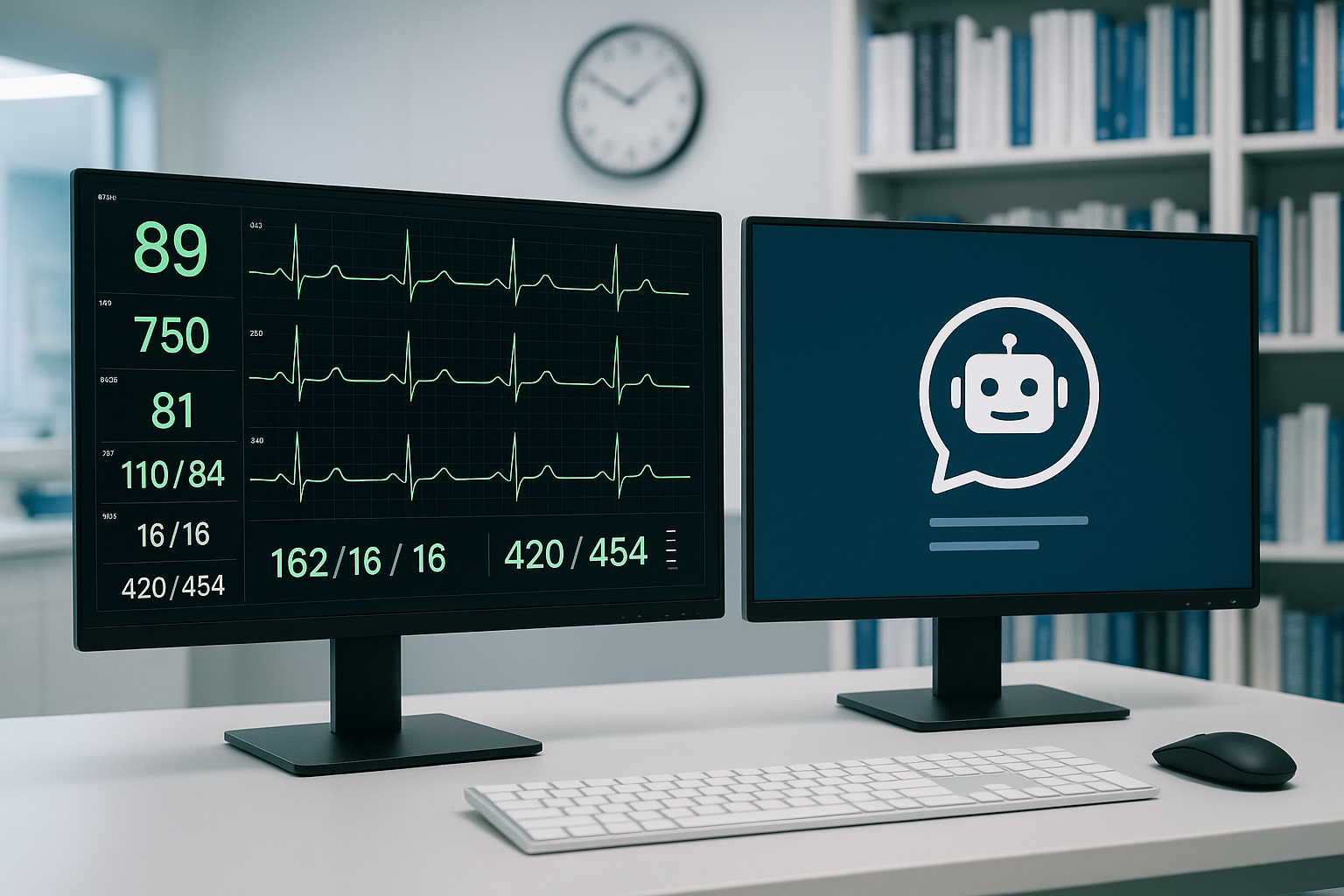
A clinician is called about a neutropenic fever in a patient two weeks post-chemotherapy.
The patient is on two medications known to prolong QT and has a borderline potassium. Given the patient’s profound neutropenia, an infectious disease note from yesterday recommends initiating levofloxacin as bacterial prophylaxis. However, this would add another QTc-prolonging agent.
She needs to know: what is the patient’s actual QTc risk? Is there a safer alternative that still covers the likely pathogens? What do national oncology protocols say about holding or substituting the current medications?
She asks ChatGPT.
It lists QT-prolonging drugs but cannot assess cumulative risk, does not have access to the patient’s most recent EKG, and hallucinates a citation about antibiotic selection. The chatbot’s response implicitly assumes the clinician has sufficient oncology, infectious disease, and pharmacy expertise to interpret and reconcile its recommendations.
She closes the tab and pages pharmacy instead.
This is the general state of AI in healthcare today. It's fluent, fast, and confident. But confidence is not the same as correctness, and fluency is not fidelity. For clinical decision-making, this fluency could introduce liability and risk.
As we move from using AI for productivity tasks to deploying it in patient care, the bar for success rises sharply and the tolerance for failure drops to near zero. A general-purpose Large Language Model (LLM) predicts the most likely next words and generates a response by sampling from those possibilities. A Clinical Decision Support system must do far more. It must contextualize specific patient data, apply evidence-based protocols, and transparently guide care.
The gap between a plausible answer and a precise one is where patient safety lives. That gap is exactly where off the shelf LLMs fall short and why the future of clinical decision support belongs to specialized agentic architectures.
The Problem: Why Chatbots Are Not Clinical Systems
Hallucination and the "Prompt" Burden
When a clinician asks a general LLM a question like, "Which antibiotic is best for my patient?" or "How should I dose vancomycin?" the off-the-shelf model does not "think" in the medical sense. It relies on the probabilistic recall of patterns learned from its training data. This probabilistic approach may introduce a cascade of failure points that make general models unfit for direct use at the bedside.
The most immediate risk is that LLMs are designed as creative engines, not truth engines. When they lack specific data, they often bridge the gap with plausible fabrications by inventing guidelines or citing non-existent studies. Compounding this, two identical prompts can produce completely different answers. This creates an unrealistic burden on the clinician to become an expert "prompt engineer." A slight change in phrasing, such as prompting "Determine dose for Drug X in a patient with renal failure" versus "Dose Drug X for a patient with a CrCl of 20," can yield vastly different recommendations. A robust clinical tool must understand medical intent regardless of syntax and not require the doctor to guess the magic words to unlock the right answer.
These risks are further compounded by model updates. Foundation model providers regularly release new versions, and a prompt that produced a reasonable recommendation last month may behave differently today, often without notice.
Even when the prompt is clear, general LLMs suffer from a failure to interrogate context. They are reactive responders rather than active investigators. If a clinician asks for a dosing recommendation but omits a critical detail, such as the patient being on dialysis, the chatbot rarely pauses to follow up or check against health system protocols or national guidelines. Instead, it confidently generates an answer based on incomplete information. A system that doesn't know what it doesn't know is a liability.
Beyond the interaction layer, there are structural constraints that further reduce reliability. First, entering Protected Health Information into public chatbots remains a compliance non-starter, forcing clinicians to rely on vague or anonymized prompts that degrade output quality. Second, while model weights are largely static, many chatbots now augment responses with live web retrieval. This replaces one limitation with another: the model, not a trained clinician, decides which sources are credible.
The Trust Deficit: The "Black Box" Problem and Lack of Clinical Context
In a clinical environment, the "why" is just as important as the "what." Historically, general LLMs operated as a "Black Box, delivering answers without showing their work. However, recent advances including chain-of-thought reasoning, and extended thinking modes have made these systems somewhat more transparent. Applications like ChatGPT and Claude now routinely explain their reasoning process and can reference sources for their conclusions.
That said, challenges remain. These models don’t always cite the specific guideline, trial, or hospital protocol that informed the recommendation with the precision clinicians need. Most likely, they don’t even have access to local guidelines and protocols. The reasoning shown may not fully reflect the model’s internal logic, and citations can be inaccurate or incomplete. These limitations compound when applied to patient-specific decisions that require the synthesis of multiple knowledge sources and longitudinal patient data. General models do not have a direct mechanism for encoding health system treatment protocols, specialist judgment, or the accumulated edge cases that define real world clinical practice.
The Determinism Gap
Finally, general models do not distinguish well between tasks that require exact answers, such as math or rule based clinical decisions, and those that allow probabilistic reasoning. They use the same stochastic approach for both, which fails when hard constraints must be enforced, such as dose calculations, maximum dose limits, absolute contraindications, or renal adjustments defined by institutional protocols. General purpose LLMs weren’t built for longitudinal medical analysis. While some chatbots can invoke tools for calculations, tool use is inconsistent, often opaque to the user, and rarely involves validated clinical calculators.
This failure is quite evident in precision dosing, where mathematical models are required to estimate drug exposure and determine an optimal dose. PK and PD calculations rely on deterministic calculations that language models cannot reliably perform. The challenge compounds further when Bayesian updating needs to be performed using a patient’s collected drug levels to predict future exposure and estimate an optimal dose. Such computations are currently not possible using any chatbot.
It’s important to note that these challenges are intrinsic to the technology. Even as LLMs improve, relying on probabilistic systems (systems that generate statistically likely outputs) for deterministic clinical tasks (tasks that demand consistent, auditable, and reproducible results) remains fundamentally challenging. The solution, therefore, is not to wait for smarter chatbots or larger models, but to build a better architecture.
The Solution: System-Centric Approach to Clinical Decision Support
Solving the reliability gap requires a shift from a model centric view to a system centric architecture. Rather than asking a single probabilistic LLM to produce an answer, this approach relies on a coordinated agentic system in which the LLM serves as an orchestrator that breaks up a clinical problem into clearly defined clinical tasks which are delegated to deterministic tools. It grounds every decision in real time patient data, and operates within strict, clinician-defined guardrails. The system must operate the way clinicians do: grounded in data, constrained by rules, transparent in reasoning. Escaping the “good enough” trap requires prioritizing three critical capabilities.
Capability 1: Agentic Orchestration
To understand why this approach is superior, we must first distinguish an Agent from a standard LLM. An LLM is a "Thinker", it predicts words but cannot act. An Agent is a "Doer." It uses the LLM as its brain but is equipped with specialized tools that allow it to execute specific actions, such as querying a database, running a calculator, or checking a guideline. By constraining how the LLM is used within an agent through explicit tools and well defined steps, the system becomes more predictable, auditable, and easier to reason about.
The most effective way to solve the Black Box and Hallucination problems is to evolve from a single, overwhelmed "Thinker" agent to a coordinated "Team of Doers." When a single model attempts multiple roles, attention drift occurs: as context expands, the model may fail to consistently attend to instructions, increasing errors.
An agentic architecture changes this by decomposing the problem. Rather than relying on a single model to do everything, the system delegates work across specialized agents with focused instruction sets, reducing attention drift and improving instruction adherence. For example, one agent might be responsible for enforcing clinical rules and checking contraindications, while another handles deterministic calculations by running a tool call to a validated external clinical calculator. A third could focus solely on retrieval-augmented synthesis, querying a curated knowledge base of trusted guidelines and grounding its output to the retrieved sources.
Consider a practical example: a clinician asks the system for a vancomycin dosing recommendation. In a general-purpose LLM, this single request would (based on one API call) simultaneously recall pharmacokinetic principles, guess at appropriate targets, attempt the AUC calculation, and infer which patient variables matter, all probabilistically.
In an agentic architecture, the request triggers a coordinated sequence. First, a retrieval agent queries a knowledge graph containing the institution's vancomycin protocol, returning the specific AUC target range and monitoring requirements approved by the local pharmacy and therapeutics committee with proper citations. Next, a designated agent makes an API call to a validated pharmacokinetic model (a deterministic step), passing in the patient's weight, renal function, and prior drug levels. The PK model returns a patient-specific dose required to reach the desired AUC target. Finally, a safety agent cross-checks the proposed dose against maximum limits and flags any relevant drug interactions. The final agent then synthesizes these outputs into a coherent recommendation for the clinician. Importantly, it has generated none of the clinical logic itself.
In this structure, the Large Language Model serves as the brain and communicator, translating the clinician’s intent and presenting the final recommendation, but it is not the source of truth for clinical logic. Instead, the clinical logic is executed by specialized agents designed for specific tasks, improving reliability, reducing hallucination risk, and enforcing hard clinical constraints. This approach converts the use of LLMs from a “Black Box” into a “Glass Box,” ensuring that every part of the decision is traceable and verifiable.
Capability 2: Deep Clinical Integration
Even the most intelligent agent is useless if it creates work for the clinician. To be effective, the system must eliminate friction at two critical points: the Input, which is what the AI agent sees, and the Output, which is what the clinician sees.
First, the system must address input friction through data and context integration. A chatbot’s failure to interrogate context forces clinicians to manually supply long patient histories and critical details. A superior system operates in an active, investigative manner. It integrates deeply with the electronic health record to capture not just raw values, but their clinical meaning. A system dosing an antibiotic needs more than a creatinine level - it needs patient context. Is the patient in the ICU? Are they on dialysis? What does the institutional protocol recommend in this situation? Have prior drug levels been collected, and if so, what are the patient-specific pharmacokinetics? By automatically injecting this state into the agent’s reasoning engine, the system removes the burden of prompt engineering from the clinician, as well as from the agent performing the assigned task.
Second, output friction must be addressed through workflow integration. In high pressure clinical settings, ease of use is a safety feature. Existing clinical decision support tools often create alert fatigue and cognitive overload, increasing the risk that critical insights are missed or ignored. The system must integrate directly into the existing workflow and present the bottom line first, including the recommendation, the confidence level, and the key supporting evidence. This minimizes cognitive load and ensures the AI agent serves the workflow rather than disrupting it.
Capability 3: Embedding Clinical Expertise into Agents
Building this architecture is not purely a software engineering challenge but a clinical one. Effective agents cannot be developed without deep domain expertise. Clinicians must be actively involved in the build phase to define the logic, priorities, and workflows that the agents follow.
Only a clinician can define which data points truly matter in which context, how they should be weighted, and when and where to rely on national guidelines given the patient scenario. Furthermore, this expertise is essential for validation - clinicians provide the complex, real-world test cases that agents must solve correctly before they are ever deployed. But the value of this involvement compounds over time. Every edge case a clinician identifies, the unusual drug interaction, the rare contraindication, the patient who doesn't fit the medical textbook, becomes a validated test case encoded into the system. This library of clinical edge cases grows with each deployment, each institution, each specialty. This is an accumulating asset that makes the system progressively more robust in exactly the scenarios where general-purpose models fail. This ensures the system reflects the actual decision making process of a clinical expert.
The Reality: Engineering Complexity and Trade-offs
It is important to acknowledge that an agentic architecture is not a silver bullet; it introduces significant engineering and operational complexity. Because the system is "thinking", chaining together multiple retrieval steps, calculations, and safety checks, it requires more computation and time than a standard chat query. This is intentional. Clinical decision support demands “System 2” thinking: slow, deliberate, and logical, rather than the fast, intuitive “System 1” behavior of a conversational chatbot.
Furthermore, maintaining this system requires rigorous governance. Validating that a rule-checking agent is correct requires extensive regression testing against "example datasets" of verified clinical scenarios. When clinical guidelines change, the underlying knowledge graphs must be updated and versioned with the same discipline as software code. Handling conflicts between agents requires careful arbitration logic defined by human experts. And because agents depend on each other's outputs, an error in an upstream component can cascade through the system; robust error handling and validation at each handoff point is essential.
In practice, the boundary between strict logic and creative reasoning is often fuzzy. A useful heuristic is to assess the "tolerance for variance": tasks that demand zero error tolerance & must be deterministic, like dose limit or safety checks. Whereas those requiring nuance and synthesis are best suited for the probabilistic strengths of the LLM. These are not trivial challenges, but they are necessary for building AI that is safe enough for patient care.
The Future: From "Artificial" to "Augmented"
The transition from general-purpose LLMs to specialized agentic systems marks the maturation of AI in healthcare. We are moving past the phase of novelty, where we were impressed that a computer could speak, and into the phase of utility, where we demand that it speaks the truth. By embracing an architecture that prioritizes orchestration, deep integration, and clinical governance, we can build tools that genuinely augment clinical expertise.
The question facing the industry is no longer whether AI belongs in clinical care, but whether we have the discipline to build it responsibly.