---
title: From Computational Models to Agentic Clinical AI
description: Explore the evolution of AI in precision dosing, from its origins to future agentic systems that enhance clinical decision-making while keeping clinicians at the center.
image: https://blog.insight-rx.com/hubfs/AI-Generated%20Media/Images/Curved%20Timeline%20with%20Dots%20and%20Icons.png
---
[](https://blog.insight-rx.com/)
- For Providers
- Solutions
- [MIPD for Providers Explore our full solution for Bayesian model-informed dosing](https://www.insight-rx.com/mipd)
- [Future of Pharmacy Learn what's next for AI in health tech, and why architecture matters](https://www.insight-rx.com/future)
- Products
- [InsightRX Nova Bayesian dosing (MIPD) app for bedside clinical decision support](https://www.insight-rx.com/provider/nova)
- [InsightRX Apollo Real-time clinical analytics to measure outcomes](https://www.insight-rx.com/provider/apollo)
- [Drug Modules Available medications for precision dosing apps](https://www.insight-rx.com/provider/drug-modules)
- [For Life Sciences](https://www.insight-rx.com/life-sciences)
- Overview
- [InsightRX for Life Sciences Explore our solution for biopharma and clinical trial use](https://www.insight-rx.com/life-sciences)
- Products
- [Nova for Life Sciences Precision dosing app for clinical trial use](https://www.insight-rx.com/life-sciences/nova)
- [Astra for Life Sciences AI-native environment for PK/PD modeling and simulation](https://www.insight-rx.com/life-sciences/astra)
- Platform
- [Continuous Learning Patented process for model retraining and improvement](https://www.insight-rx.com/platform/continuous-learning)
- [Integrations Platform interoperability setup with EHRs, EDCs, and more](https://www.insight-rx.com/platform/integrations)
- [Security & Regulatory Standards for product development and release](https://www.insight-rx.com/platform/security-regulatory)
- [Success & Support Pharmacist-led training, onboarding, and education](https://www.insight-rx.com/platform/support)
- Resources
- Science
- [Data Science Explore the science and learn more about our R&D](https://www.insight-rx.com/data-science)
- [Scientific Publications Impactful research manuscripts with at least one InsightRX author](https://www.insight-rx.com/data-science/scientific-publications)
- [How to Cite Using one of our apps? Follow this easy guide for citation in research](https://www.insight-rx.com/how-to-cite-insightrx-nova)
- Explore
- [Success Stories Case studies from real InsightRX customers about their journey](https://www.insight-rx.com/success-stories)
- [White Papers In-depth analysis and best practices for review and download](https://blog.insight-rx.com/resources/tag/white-papers)
- [Pubs. Using InsightRX Review research that has used InsightRX applications](https://www.insight-rx.com/publications-using-insightrx-software)
- [Blog](https://blog.insight-rx.com/resources)
- [All Blog Posts Read the latest posts by our team of experts](https://blog.insight-rx.com/resources)
- [Product Innovation The latest updates on our products, services, and science](https://blog.insight-rx.com/resources?section=product_innovation)
- [Thought Leadership Posts from our team of experts on PK, MIPD, science, and more](https://blog.insight-rx.com/resources?section=thought_leadership)
- Company
- About
- [About Us Our story, what drives us and why we're passionate about our work](https://www.insight-rx.com/about)
- [Leadership Founders and team leaders who strive toward excellence in MIPD](https://www.insight-rx.com/leadership)
- [Advisory Board Scientists and experts to ensure our collective success](https://www.insight-rx.com/advisory-board)
- [Careers Interested in joining? View available openings here](https://www.insight-rx.com/careers)
- [Customers Hear what others have to say about their experience](https://www.insight-rx.com/customers)
- Press
- [All Stories InsightRX news, company updates, and more](https://blog.insight-rx.com/press-releases)
- [Press Releases Announcements for events, partnerships, and company updates](https://blog.insight-rx.com/press-releases?section=press_releases)
- [Media InsightRX in the news — digital, print, podcasts, and other outlets](https://blog.insight-rx.com/press-releases?section=media)
[](https://cta-service-cms2.hubspot.com/web-interactives/public/v1/track/redirect?encryptedPayload=AVxigLIVhNAV4frdGw7WK4%2FsUL9BSW7sTFfaUWeB6c0miW6Ak22RBUNE5R8BeaQrWqzDSork53FkrNEqiSn%2FTM4f%2BVzPNcA0Ikxp7y6GqZRUQJ2HulFNF849cXXSebQBDVQXFR3hVvn8tZ3jkxYoygqRgjFUwIOapgI0FM8UFCm2xhxz2SgLhEGqk1U%3D&webInteractiveContentId=193831493462&portalId=40041574)
[](https://cta-service-cms2.hubspot.com/web-interactives/public/v1/track/redirect?encryptedPayload=AVxigLIVhNAV4frdGw7WK4%2FsUL9BSW7sTFfaUWeB6c0miW6Ak22RBUNE5R8BeaQrWqzDSork53FkrNEqiSn%2FTM4f%2BVzPNcA0Ikxp7y6GqZRUQJ2HulFNF849cXXSebQBDVQXFR3hVvn8tZ3jkxYoygqRgjFUwIOapgI0FM8UFCm2xhxz2SgLhEGqk1U%3D&webInteractiveContentId=193831493462&portalId=40041574)
Thought Leadership
# From Computational Models to Agentic Clinical AI
- Published June 10, 2026
By [Sirj Goswami](https://blog.insight-rx.com/resources/author/sirj-goswami)
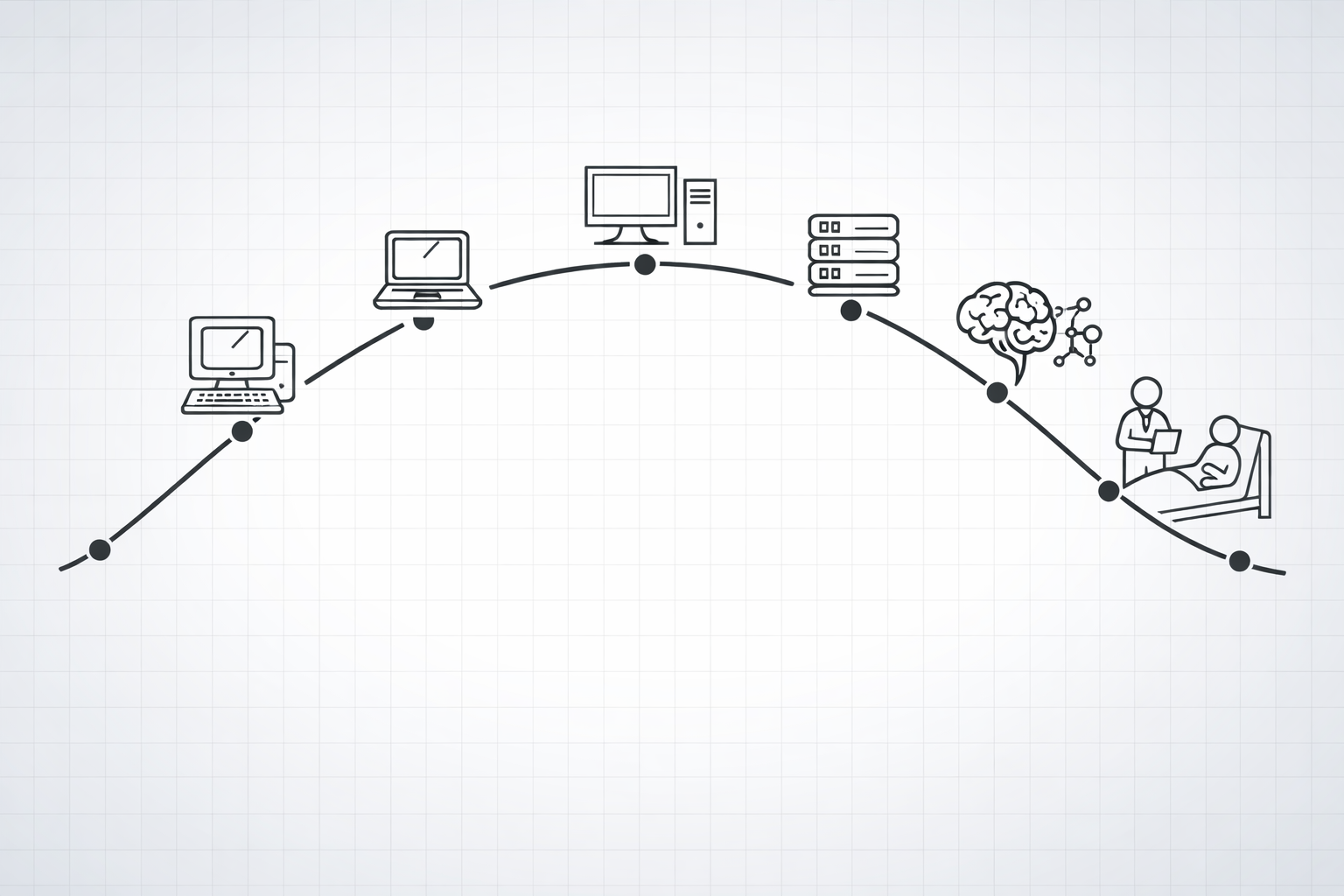
I recently gave a talk at the 2026 Presbyterian College School of Pharmacy Preceptor Workshop on the history of AI in precision dosing and where the field is headed next. One point I wanted to make clear from the start is that AI in healthcare did not begin with ChatGPT.
Over the last few years, the conversation around AI has exploded. Every company has an AI strategy. Every product has an “AI-powered” label attached to it. It can feel like AI in healthcare suddenly appeared in 2022. But in precision dosing, AI has been evolving for more than five decades.
The journey starts in 1969 with Dr. Lewis Sheiner, one of the founders of modern pharmacometrics. Long before anyone used the term “artificial intelligence” in medicine, Sheiner [published work](https://pubmed.ncbi.nlm.nih.gov/5367362/) exploring whether computers could help individualize warfarin dosing using patient-specific data and mathematical models. The core idea was remarkably similar to what we still pursue today: use computation to improve clinical decision-making. That work eventually led to population pharmacokinetics, Bayesian dosing, NONMEM, and the broader field of [model-informed precision dosing (MIPD)](https://www.insight-rx.com/provider).
By the 1980s and 1990s, much of the underlying science existed, and early clinical dosing tools had started to emerge, but adoption remained limited. What didn’t exist was the infrastructure to scale it. Systems lacked EHR integration, workflows were manual, and the tools remained largely confined to academic centers.
The 2010s changed that. EHR adoption accelerated, cloud computing matured, and interoperability standards like FHIR made scalable clinical platforms possible. Precision dosing systems could finally operate at the bedside across large health systems. And something important happened as these systems scaled: the models themselves improved from real-world clinical data. Population PK models became more accurate across special populations like pediatrics, obesity, and renal impairment as more data flowed through the platforms. In many ways, this was already machine learning. The systems were continuously improving predictions based on accumulated data. It just didn’t resemble the modern consumer AI wave people associate with ChatGPT.
What changed in the 2020s was not the arrival of AI itself, but the emergence of a far more unified and capable generation of AI systems. Large language models (LLMs) unified and dramatically advanced capabilities that previously existed across fragmented NLP techniques: understanding unstructured text, synthesizing broad information, and communicating naturally with humans. Rather than relying on brittle multi-model pipelines that often felt clunky and unnatural, LLMs enabled AI systems to perform these tasks in a far more adaptable, conversational, and intuitive way for clinicians and patients.
That shift matters, but it also created confusion; general-purpose chatbots are often being mistaken for clinical systems, and those are [not the same thing](https://blog.insight-rx.com/resources/from-chatbots-to-bedside-ready-ai-systems). Clinical decision-making, especially in precision dosing, requires deterministic calculations, hard safety constraints, validated workflows, and reproducible outputs. General-purpose LLMs were not designed for that. They can hallucinate, fail to ask clarifying questions, ignore institutional constraints, and generate different answers to the same problem. That does not mean LLMs are useless in healthcare. Quite the opposite: I believe they will fundamentally reshape clinical workflows. But the architecture matters enormously.
The future is not a smarter chatbot making autonomous clinical decisions. The future is agentic systems built around transparency, specialized reasoning engines, and enforceable clinical constraints. A general-purpose chatbot is fundamentally a black box. You ask a question, get an answer, and have limited visibility into how the system arrived there. Clinical care cannot operate that way.
Agentic systems flip that model. The LLM acts as an orchestrator, not an oracle. A clinical question is broken into smaller components, each handled by specialized agents or validated tools designed for a specific task.
Some agents encode knowledge such as formularies, protocols, antibiograms, and evidence-based guidelines. Others perform PK/PD simulations, Bayesian dose optimization, and broader clinical calculations through validated pharmacometric and rules-based engines. Safety constraints, dose ceilings, contraindications, formulary restrictions, and institutional policies are enforced architecturally rather than left to probabilistic interpretation by the LLM. This is where precision dosing becomes especially important in the broader AI conversation. The PK/PD layer is not replaced by the LLM; it becomes one of the foundational reasoning engines within the agentic architecture itself.
In other words, precision dosing evolves from a standalone dosing workflow into a broader clinical decision support capability. The same validated PK/PD engines that optimize dosing can now operate alongside agents synthesizing microbiology, laboratory data, institutional guidance, patient-specific risk factors, and longitudinal clinical context simultaneously.
In the talk, I walked through what this could look like within an agentic clinical workflow. Different agents operate across specialized domains, retrieving and synthesizing patient context, evaluating evidence and institutional knowledge, performing pharmacometric calculations, validating safety constraints, and coordinating broader therapy optimization tasks. Importantly, these agents do not operate freely or independently. They function within a safety harness built around deterministic tool calls and enforceable clinical rules. The agent itself is not inventing clinical logic or “guessing” recommendations. It is orchestrating computational and clinical decision-making frameworks underneath it.
One of the important tools I highlighted is the clinical knowledge graph. Healthcare decision-making is deeply relational: drugs interact with organisms, organisms connect to resistance patterns, therapies carry toxicities, and patient-specific factors influence every layer of the decision process. Knowledge graphs allow agents to reason across these relationships in a structured, traceable, and clinically grounded manner rather than relying solely on unstructured language prediction.
The clinician ultimately receives a synthesized recommendation with transparent calculations, supporting rationale, citations, and institutional constraints already incorporated into the workflow. Importantly, this also expands what precision dosing platforms can become. Historically, many PK/PD systems were confined to isolated dosing workflows. Agentic architectures allow pharmacometric engines to operate as components within broader clinical decision-support systems spanning therapy optimization, medication safety, and longitudinal medication management.
Through all of it, the clinician remains at the center, which might be the most important through-line across the [last 57 years of this field](https://www.insight-rx.com/future). From Sheiner’s early work in 1969 to modern agentic AI systems, the goal has remained remarkably consistent, which is to use computation to augment clinical judgment, not replace it.
[AI](https://blog.insight-rx.com/resources/tag/ai) [MIPD](https://blog.insight-rx.com/resources/tag/mipd) [industry trends](https://blog.insight-rx.com/resources/tag/industry-trends)
#### On this page…
About the author
[Sirj Goswami, PhD](https://blog.insight-rx.com/resources/author/sirj-goswami)
CEO and Co-founder of InsightRX
Sirj is a scientist, entrepreneur and healthcare technology enthusiast. Prior to InsightRX, Sirj spent several years working within the Biopharma industry, supporting the clinical development of new drugs as a pharmacometrician and data scientist at Pfizer and Genentech. Sirj was an FDA fellow at the University of California, San Francisco, and received his PhD in pharmacogenomics and pharmacometrics, with a dissertation focus on optimizing therapy in patients with Type 2 Diabetes.
**Connect with us to get the latest blog updates, instantly sent to your inbox**
## Dig deeper.
Explore related articles and additional posts on the InsightRX blog.
[Thought Leadership Feb 10, 2026 From Chatbots to Bedside-Ready AI Systems](https://blog.insight-rx.com/resources/from-chatbots-to-bedside-ready-ai-systems) [Thought Leadership Jul 18, 2018 The Right Dose: How Pharmacy Researchers Are Making Medicine More Precise](https://blog.insight-rx.com/resources/right-dose-pharmacy-researchers-making-medicine-precise) [Thought Leadership Jul 3, 2023 How Clinical Decision Support for Precision Dosing Can Enhance Healthcare Equity and Inclusion](https://blog.insight-rx.com/resources/precision-dosing-can-enhance-healthcare-equity-inclusion)
#### What We Do
##### For Providers
- [Nova (Bayesian Dosing)](https://www.insight-rx.com/provider/nova)
- [Apollo (Clinical Analytics)](https://www.insight-rx.com/provider/apollo)
- [Drug Modules](https://www.insight-rx.com/provider/drug-modules)
##### For Life Sciences
- [Nova (MIPD for Clinical Trials)](https://www.insight-rx.com/life-sciences/nova)
- [Astra (AI-Powered Clin Pharm)](https://www.insight-rx.com/life-sciences/astra)
- [Companion Applications](https://www.insight-rx.com/life-sciences/nova#companion-applications)
#### How We Do It
##### Platform
- [Continuous Learning](https://www.insight-rx.com/platform/continuous-learning)
- [Integrations](https://www.insight-rx.com/platform/integrations)
- [Security & Regulatory](https://www.insight-rx.com/platform/security-regulatory)
- [Success & Support](https://www.insight-rx.com/platform/success-support)
##### Science
- [Data Science](https://www.insight-rx.com/data-science)
- [Scientific Publications](https://www.insight-rx.com/data-science/scientific-publications)
#### Information
##### Resources
- [Success Stories](https://www.insight-rx.com/success-stories)
- [White Papers](https://www.insight-rx.com/white-papers)
- [Publications Using InsightRX](https://www.insight-rx.com/publications-using-insightrx-software)
- [How to Cite InsightRX](https://www.insight-rx.com/how-to-cite-insightrx-nova)
##### Blog
- [All Posts](https://blog.insight-rx.com/resources)
- [Product Innovation](https://blog.insight-rx.com/resources?section=product_innovation)
- [Thought Leadership](https://blog.insight-rx.com/resources?section=thought_leadership)
#### About
- [Our Story](https://www.insight-rx.com/about)
- [Leadership](https://www.insight-rx.com/leadership)
- [Advisory Board](https://www.insight-rx.com/advisory-board)
- [Our Customers](https://www.insight-rx.com/customers)
- [Press Releases](https://blog.insight-rx.com/press-releases?section=press_releases)
- [Media](https://blog.insight-rx.com/press-releases?section=media)
- [Careers](https://www.insight-rx.com/careers)
- [Contact](https://www.insight-rx.com/contact-us)
---

InsightRX Nova is HITRUST CSF r2 certified, CE marked, and 21 CFR Part 11 compliant. Our quality management, risk management, software lifecycle, and usability engineering processes conform to ISO 13485, IEC 62304, ISO 14971, IEC 62366-1, and IEC 82304-1.
InsightRX Nova is not considered to be a medical device in the U.S. and has not been submitted to the U.S. Food and Drug Administration for review or clearance.
740-05000-REC-01 · 08/2025
---
[](https://www.insight-rx.com/)
548 Market Street
#88083
San Francisco, CA 94104
---
© 2026 InsightRX, Inc. All rights reserved.
[Privacy Policy](https://www.insight-rx.com/privacy-policy) Cookie Preferences
```json
{
"@context" : "https://schema.org",
"@type" : "BlogPosting",
"author" : {
"@type" : "Person",
"name" : "Sirj Goswami, PhD - CEO and Co-founder of InsightRX",
"url" : "https://blog.insight-rx.com/resources/author/sirj-goswami"
},
"dateModified" : "2026-06-11T04:11:08.318Z",
"datePublished" : "2026-06-10T22:31:00.000Z",
"headline" : "From Computational Models to Agentic Clinical AI",
"image" : [ "https://blog.insight-rx.com/hubfs/AI-Generated%20Media/Images/Curved%20Timeline%20with%20Dots%20and%20Icons.png" ],
"mainEntityOfPage" : {
"@id" : "https://blog.insight-rx.com/resources/from-computational-models-to-agentic-clinical-ai",
"@type" : "WebPage"
},
"publisher" : {
"@type" : "Organization",
"logo" : {
"@type" : "ImageObject",
"url" : "https://blog.insight-rx.com/hubfs/insightrx_logo_color%20500%20x%20250-1.png"
},
"name" : "InsightRX"
}
}
```