


A single population pharmacokinetic (popPK) model can optimally dose amikacin, gentamicin, and tobramycin across the entire human lifespan. It predicts drug concentrations more accurately than the best published models built one drug and age group at a time. That's the finding from our new Editor's Choice article in the Journal of Clinical Pharmacology.
Why aminoglycoside dosing is hard
Amikacin, gentamicin, and tobramycin are workhorse antibiotics for gram-negative infections, but they have a narrow therapeutic window and carry risks of ototoxicity and nephrotoxicity, especially at elevated serum concentrations. That is why therapeutic drug monitoring (TDM) is recommended. These drugs are also strong candidates for model-informed precision dosing (MIPD), which is only as good as the popPK model behind it.
Until now, those popPK models for aminoglycosides were a patchwork, mostly fit on one drug and one population at a time each estimated from its own small slice of data. Could a neonatal model or a pediatric model work for a 50-year old patient? What about a 19 year old—are they a child or an adult? But our hypothesis was that pooling data across age groups and drugs to develop a unified model could generate a smooth maturation and age-related decline curve, and therefore improve predictive performance.
The question: pool or specialize?
The three drugs are close pharmacokinetically: hydrophilic, distributed largely in the extracellular fluid, and cleared almost entirely renally. The differences between neonatal, pediatric, and adult patients are mostly a matter of renal maturation, which is a continuous biological process. If the underlying physiology is shared across both drug and age group, does pooling the data beat individual specialized models?
What we did
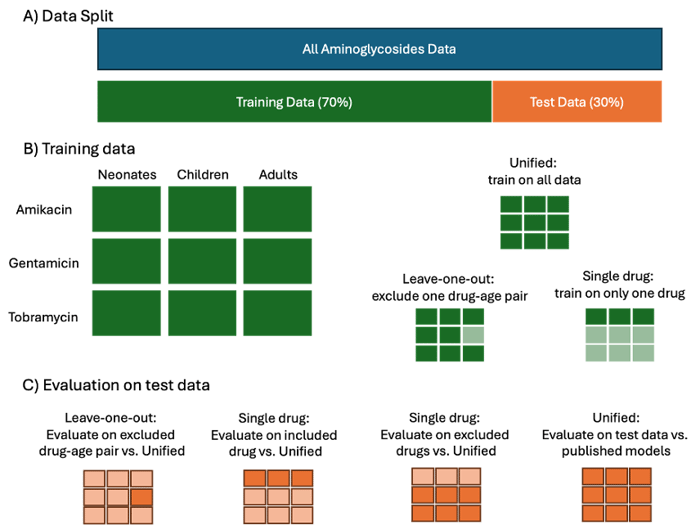
Figure 1. We split the available data from 5,659 patients into a training data and a test data set. We fit a unified model on all of the training data, three single drug models to evaluate where the unified model was better than single drug models, and nine leave-one-drug-age-group-out models to evaluate how well the model could handle a missing group in the data.
So how did we test this pooling hypothesis?
- Split de-identified data from 5,659 amikacin, gentamicin, and tobramycin patients across 154 U.S. hospital systems, spanning the first days of life through to age 100, into training and testing sets.
- Fit one shared physiological structure, with allometric scaling, a maturation function for clearance (representing kidney development), an age-related decline in clearance, a serum creatinine effect, and a cystic fibrosis effect for tobramycin patients. These were fit jointly across all three drugs and every age group, and we only retained drug-specific terms where the data supported them.
- Compared predictive performance across the best published models available in InsightRX Nova for each drug/age group combination, using mean percent error (MPE), normalized root mean square error (nRMSE), and clinical accuracy (troughs correctly classified as >1 or <1 mg/L, and non-trough levels within 20% of measured values).
- Tested generalizability by training models on single-drug (e.g. amikacin only, see Figure 1B) and leave-one-out (e.g. missing gentamicin data for neonates) and evaluating on the whole test set.
Key finding: the unified model won across the board
On the held-out test data set, the unified model had the lowest nRMSE in every age group, with relative reductions of 0.6% to 24.8% versus the best published models, and the highest clinical accuracy. The improvement was clearest in children, where a posteriori accuracy reached 55.1%, compared with 47.8% for the best published pediatric model.
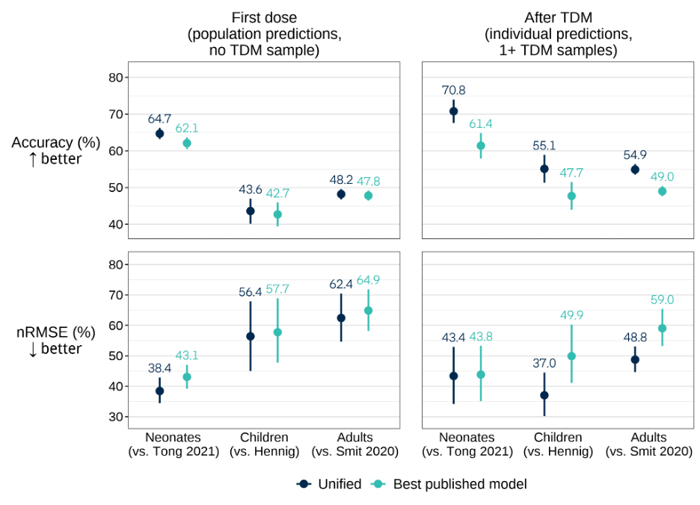
Figure 2. Accuracy and normalized root mean square error (nRMSE) of predictions for the new unified model and best published models on the test data set. Error bars indicate 90% confidence intervals.
To make sure it was the pooling that helped, we fit three single-drug models (e.g. amikacin only), and nine leave-one-drug-age-group-out models (e.g. missing gentamicin data for neonates). Leave-one-out refits produced similar popPK model parameter estimates, but there was more uncertainty around these parameter estimates. Each of these single-drug models was less predictive than the unified model.
The bigger pattern: pool what's shared, specialize what isn't
This paper is part of a question we keep returning to: do special subpopulations need their own bespoke model, or can a well-specified general model capture the variation on its own? The answer depends on the case.
For pediatric oncology patients receiving vancomycin, a pooled meta-model outperformed specialized oncology models while in pediatric CVICU patients, a specialized model did better. Pooling doesn't always win, but model choice should rely on external, empirical evaluation rather than on assumptions about a population.
Here, we pooled aspects of physiology that these three aminoglycosides share (maturation, allometric scaling, and renal elimination) while keeping drug-specific terms where the data called for them. Pool what's shared, specialize what isn't, based on the available evidence. This model demonstrates that a single well-specified model can span a drug class and the whole lifespan without giving up the differences that matter.
There's a mechanism underlying this. When the shared physiology is estimated jointly, the subpopulations with abundant data can lend their information to the ones without. What we learn from a well-sampled group, like gentamicin in neonates, helps the model handle other groups that are less richly sampled, like amikacin in neonates. That is what the leave-one-out refits show; that even with an entire drug-age group removed, the shared structure produced sensible parameter estimates, just with more uncertainty around them. We've also shown this before in continuous renal replacement therapy patients treated with vancomycin, where we used a population of non-CRRT patients to inform general vancomycin PK, then added terms for how CRRT patients diverge.
Recommendation for practice
The practical payoff is a single model that is most accurate across the board, one model to validate and maintain instead of many. This unified model is already available in InsightRX Nova (you'll find it as "All ages/general (Tong, J Clin Pharmacol 2026"), and we recommend it as the default model for dosing amikacin, gentamicin, and tobramycin for all age groups.
Want to learn more?
The full study ("One model to dose them all: a population pharmacokinetic model for multiple aminoglycosides across the human lifespan") is available open access at the Journal of Clinical Pharmacology.