

In June 2025, the National Kidney Foundation published a consensus statement to transition away from Cockcroft-Gault estimated creatinine clearance (C-G eCrCL) and towards the 2021 race-free CKD-EPI estimated glomerular filtration rate (CKD-EPI eGFR) equations when dosing renally-eliminated drugs in adults. The statement, however, did not address model-informed precision dosing (MIPD), in which doses are tailored to patients through the use of a population pharmacokinetic (popPK) model. For renally-cleared medications like vancomycin, these popPK models often use C-G eCrCL as a predictor of drug clearance.
This raises an important question for clinical pharmacists using InsightRX Nova:
If a model was built on C-G eCrCL, is it appropriate to use these models for MIPD with CKD-EPI eGFR instead?
For general adult vancomycin models, the answer is yes. But for models developed exclusively in patients with obesity it isn’t, because that is where the two equations disagree most. Our Data Science team investigated this question using real-world clinical data from 10,359 adult patients receiving intravenous vancomycin across 199 US hospital systems, incorporating a total of 32,001 serum vancomycin levels.
Following our efforts to enhance inclusion and equity in healthcare, we used a deliberate sampling strategy to build a diverse and balanced sample, with patients spanning the full range of sex, age, body size, and kidney function—with equal representation of all combinations across this range—so our findings should be relevant for most patients. When substituting CKD-EPI eGFR, we adjusted the standardized eGFR values (mL/min/1.73m2) for a patient’s body surface area so they were in the same units as C-G eCrCL (mL/min).
Key finding: Substituting CKD-EPI eGFR improves some models but worsens others
Figure 1 shows what happened when we substituted CKD-EPI eGFR into several published popPK models built with C-G eCrCL, then compared their predictive performance against the originals. We assessed two kinds of prediction:
- Population predictions, made from the model and a patient’s characteristics before any vancomycin levels were available, and
- Individual predictions, made once Bayesian estimation had tailored the model to that patient’s measured levels.
Across these adult vancomycin models available in InsightRX Nova, the switch:
- Improved predictions for three of five models: Buelga 2005, Goti 2018, and Thomson 2009—with lower error, higher accuracy, and bias closer to zero.
- Left error and accuracy about the same for one model: Carreno 2017, but worsened its bias.
- Worsened predictions for one model: Adane 2015, with higher error, lower accuracy, and bias further from zero.
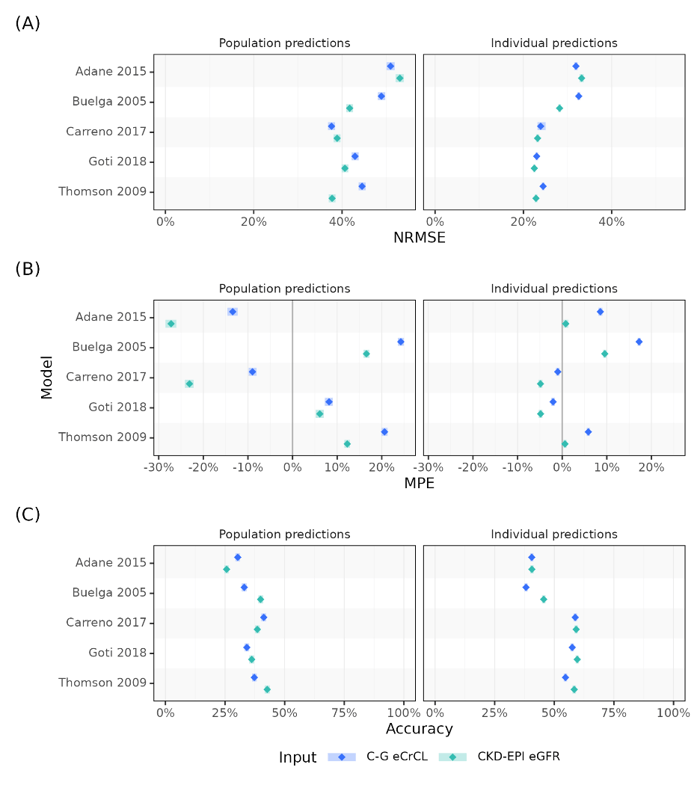
Figure 1. Predictive performance of the published adult vancomycin models using either C-G eCrCL or CKD-EPI eGFR as covariate inputs, assessed using normalized root mean square error (NRMSE), mean percent error (MPE), and accuracy. Error bars represent the point and the 95% confidence interval estimate for each model. For MPE, the solid vertical line represents a value of zero bias.
Why body size decides the outcome
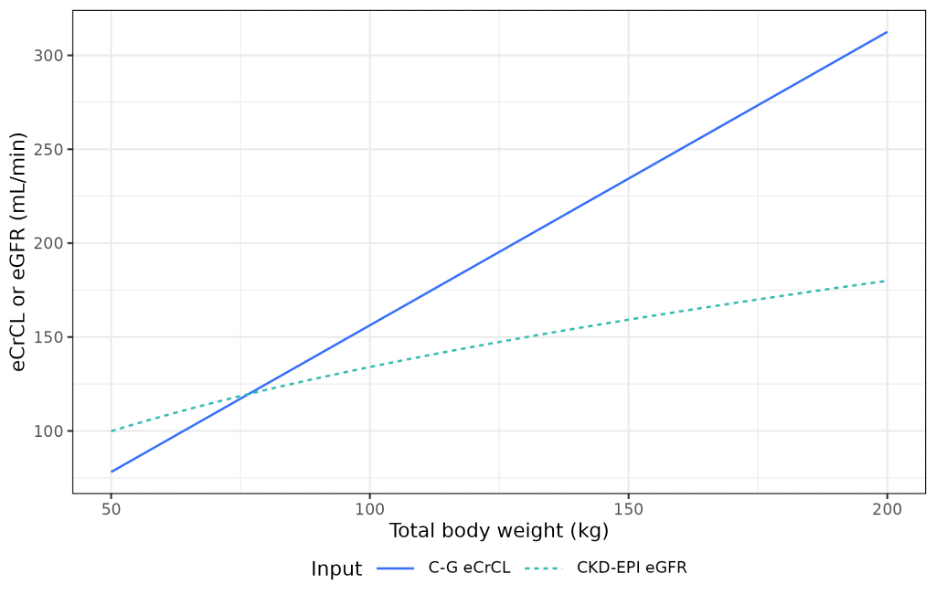
The two renal function estimation equations disagree in a specific, predictable way as shown in Figure 2: C-G eCrCL scales directly with total body weight, so it climbs steeply as patients get heavier. However, CKD-EPI eGFR adjusted for a patient’s body surface area rises far more gradually. The two therefore diverge with increasing body size. Substituting CKD-EPI eGFR applies a weight-dependent downward shift to the kidney function value a model receives, and with it to the clearance a model predicts.
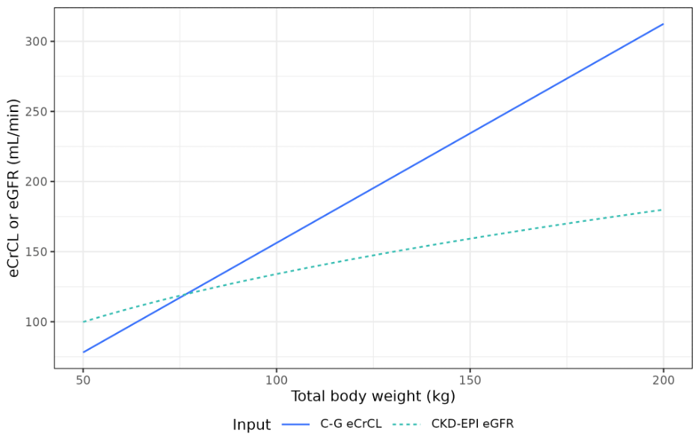
Figure 2. Change in C-G eCrCL and CKD-EPI eGFR as a function of total body weight for an example 50 year old male patient 175 cm tall with a serum creatinine level of 0.8 mg/dL.
How the weight-dependent downward shift affects predictive bias
Whether this weight-dependent shift helps or hurts depends on which way a model was already biased. Figure 3 illustrates this by showing what happened to each model’s population prediction MPE estimates when substituting CKD-EPI eGFR across different body sizes:
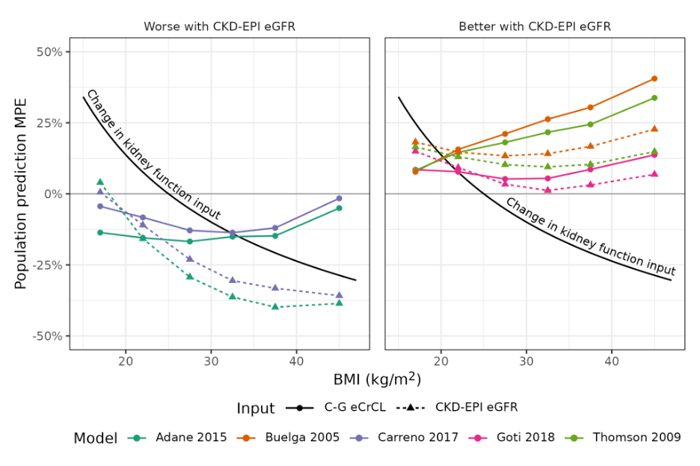
Figure 3. Population prediction MPE by BMI, for models where substituting CKD-EPI eGFR worsened (left) or improved (right) predictive performance. Points are plotted at the midpoint of each BMI category. The black curve shows the expected change in kidney function input that substitution produces for an example 50 year old male patient 175 cm tall with a serum creatinine level of 0.8 mg/dL.
The downward shift affected each model differently
The Buelga 2005, Goti 2018, and Thomson 2009 models increasingly over-predicted vancomycin clearance at higher BMI under their original C-G eCrCL input, whereas the Adane 2015 and Carreno 2017 models had a relatively stable bias across the BMI range. The downward shift flattened the positive gradient in the Buelga 2005, Goti 2018, and Thomson 2009 models, reducing the magnitude and variability of bias in population predictions across BMI categories above 25 kg/m2; but in the Adane 2015 and Carreno 2017 models there was no gradient to correct, so the same shift introduced a negative gradient that tracked the expected change in kidney function input almost exactly.
The same mechanism ran in reverse at the lowest end of the BMI range
Where the two equations cross over, CKD-EPI eGFR returns the higher value, so substitution raises the kidney function value a model receives rather than lowering it, and bias moves in the positive direction accordingly. For patients with a BMI below 18.5 kg/m2, bias improved in the Adane 2015 and Carreno 2017 models, and worsened slightly in the Buelga 2005, Goti 2018, and Thomson 2009 models, alongside small losses in error and accuracy. Between 18.5 and 24.9 kg/m2 the two equations agree most closely, and bias is similar regardless of which equation was used.
What this means for models built in patients with obesity
Both models harmed by the switch—Adane 2015 and Carreno 2017—were developed exclusively in patients with obesity, unlike the three models that improved with CKD-EPI eGFR, which were developed in patients across a wider range of body sizes. The clearance terms in these two models are calibrated to the way C-G eCrCL behaves in patients with obesity, which is exactly the relationship substituting CKD-EPI eGFR disrupts because it rises far less steeply with body size and therefore returns much lower values in these patients. The model reads that lower number as a patient who clears vancomycin more slowly, so it estimates lower clearance and predicts higher concentrations for a given dose, creating a systematic bias that grows with BMI.
Substituting CKD-EPI eGFR for C-G eCrCL therefore does most harm to these models in the patients they were built to help.
A similar pattern with age
We saw similar trends with age, because the two equations reduce kidney function at different rates as patients get older: C-G eCrCL starts higher in most patients and falls faster, so in younger patients substituting CKD-EPI eGFR lowers the kidney function value a model receives, and in older patients it raises it. Bias shifted accordingly in all five models—crossing over at 65–80 years—with increased bias above 80 years in the Buelga 2005, Goti 2018, and Thomson 2009 models. However, the age-related penalty to overall predictive performance was small relative to the trends we saw for BMI.
Explore the substitution for your own patient
Everything above follows from the two equations themselves, not from any model, so the direction and size of the shift can be worked out for any patient from sex, age, height, weight, and serum creatinine alone.
You can explore this for your own patient using the interactive widget below:
Recommendations for practice
Our findings extend the National Kidney Foundation’s guidance to adopt CKD-EPI eGFR over C-G eCrCL to vancomycin MIPD:
InsightRX now recommends using CKD-EPI eGFR for MIPD in place of C-G eCrCL for general adult vancomycin models developed using C-G eCrCL, including Buelga 2005, Goti 2018, and Thomson 2009.1
New versions of these models with CKD-EPI eGFR are now available in InsightRX Nova and Gemini for all customers using the adult vancomycin module. For these models:
- Substitution improved or gave equivalent predictive performance across error, accuracy, and bias for most patient groups, without any need to re-estimate model parameters.
- Increased bias was observed in patients with a BMI below 18.5 kg/m2 or age above 80 years, but this resulted in only small losses to predictive performance.
- Using CKD-EPI eGFR aligns MIPD with professional guidance for general medical and medication-related decision-making, so dosing decisions stay consistent with the rest of clinical practice.
For models developed specifically in patients with obesity, including Adane 2015 and Carreno 2017, InsightRX recommends retaining the model’s original C-G eCrCL input for the best predictive performance.
- Note that many of our recommended vancomycin models, including the Brooks 2026 model for young adults and the Tong 2026 model for adults receiving CRRT, were already developed using CKD-EPI eGFR!